Self-Care for Anxiety: Simple Routines That Actually Help
Self-Care for Anxiety: Calming Routines, Mindfulness, and Coping Tools That Fit Real Life
Anxiety can feel loud, fast, and hard to switch off. Practical self-care isn’t about doing everything “perfect”—it’s about building small, repeatable actions that signal safety to the body and create space between a trigger and a reaction. Use the ideas below to create a personalized calming routine for daytime stress, nighttime worry, and those moments when anxiety spikes.
What “self-care for anxiety” actually means
Self-care for anxiety works best when it supports the nervous system first—because when the body is revved up (tight chest, tense muscles, shallow breathing), the mind tends to follow. The goal isn’t to erase anxious thoughts on command; it’s to lower physical arousal so thoughts become easier to handle and choices become easier to make.
- It focuses on nervous-system support: lowering heart rate, easing muscle tension, and slowing breathing so the “alarm” quiets down.
- It works best as a toolkit: a few quick tools for spikes plus a simple daily routine for a steadier baseline.
- It pairs action with compassion: self-care isn’t avoidance; it’s skill-building, recovery, and pacing.
- It complements professional support: if symptoms are intense, persistent, or impairing, self-care can support therapy or medical care—not replace it. (For background, see NIMH’s overview of anxiety disorders.)
Common anxiety moments and the most helpful self-care focus
| Moment | What it feels like | Best self-care focus |
|---|---|---|
| Sudden spike/panic | Racing heart, dizziness, urgency | Grounding + slow-exhale breathing + cold water/sensory reset |
| Low-grade worry loop | Rumination, difficulty focusing | Thought labeling + scheduled worry time + values-based next step |
| Overwhelm/burnout | Irritability, fatigue, shutdown | Reduce inputs + gentle movement + nourishment + boundaries |
| Nighttime anxiety | Restlessness, scrolling, insomnia | Wind-down ritual + body scan + screen cutoff + journaling |
A quick calming sequence for anxious moments (5–10 minutes)
When anxiety spikes, the most helpful routine is the one you can remember while you’re activated. Keep this sequence simple, repeatable, and slightly “automatic.”
- Name it: silently label what’s happening (for example, “anxiety is rising”). This helps create distance from the feeling.
- Exhale-first breathing: inhale gently for 3–4 seconds, then exhale for 5–7 seconds. Do 6–10 rounds, letting the exhale be soft and unforced.
- Ground in senses: identify 5 things you see, 4 you feel, 3 you hear, 2 you smell, 1 you taste.
- Release tension: unclench your jaw, drop your shoulders, soften your hands; add a slow neck or shoulder roll.
- Choose one next action: drink water, step outside for 2 minutes, text a support person, or write a one-line plan.
If panic-like episodes are frequent, escalating, or feel unsafe, consider getting professional support. Resources like the American Psychological Association’s anxiety hub can help you understand common symptoms and treatment options.
Daily self-care that lowers baseline anxiety
Think “baseline” rather than “breakthrough.” Small daily inputs can reduce overall nervous-system load so spikes happen less often and feel less intense when they do.
- Micro-movement: 5–15 minutes of walking, stretching, or gentle strength work can discharge stress activation and improve mood predictability.
- Steady fuel: regular meals and protein-forward snacks help reduce jittery, crash-prone energy swings that can mimic anxiety.
- Caffeine check: experiment with timing and dose; try replacing one serving with water or herbal tea for a week and notice changes.
- Light and rhythm: morning daylight exposure and consistent sleep/wake times can support steadier regulation.
- Tiny boundaries: one “no” per week, one protected break per day, and one notification-free focus block.
Some people also find that simple comfort cues—like warm layers during evening wind-down—make routines easier to stick to. If cozy “signal items” help you shift into calmer mode, consider keeping something dedicated to rest time, such as the Prada Polo Sweater, as a consistent, sensory cue for downtime.
Mindfulness that feels doable (even when the mind won’t quiet down)
Mindfulness doesn’t require an empty mind. It’s the skill of noticing what’s happening without wrestling it. When anxiety is high, shorter and more body-based practices often work better than long, silent sits.
Coping tools for recurring triggers
A printable-style guide to keep the tools in one place
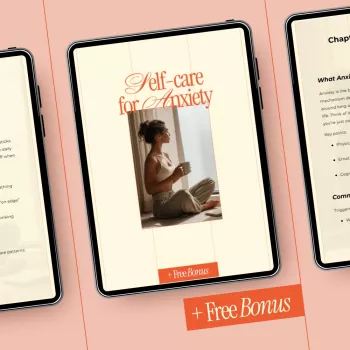
If you want an organized set of prompts you can keep on your device or print, the Self-Care for Anxiety | Calming Anxiety Relief eBook (Digital Download) is designed to help you build a practical routine you can actually repeat.
FAQ
What is a simple self-care routine for anxiety?
Try a 3-part routine: morning daylight plus 5 minutes of movement, a midday 60-second breathing/grounding break, and an evening wind-down with a screen cutoff and a quick journal note. Start small and repeat daily so your body learns the pattern.
How can mindfulness help with anxiety when thoughts won’t stop?
Mindfulness helps by changing your relationship to thoughts—notice them without arguing with them. Use an anchor (breath, feet, sounds), label distractions, keep practices short, and switch to external grounding if internal focus makes you feel worse.
What can help during an anxiety spike or panic-like moment?
Use a quick sequence: name the anxiety, slow the exhale, ground in your senses, release muscle tension, then choose one small next action (water, fresh air, a text to support). If episodes are frequent or severe, seek professional help to rule out medical causes and get targeted treatment.







Leave a comment